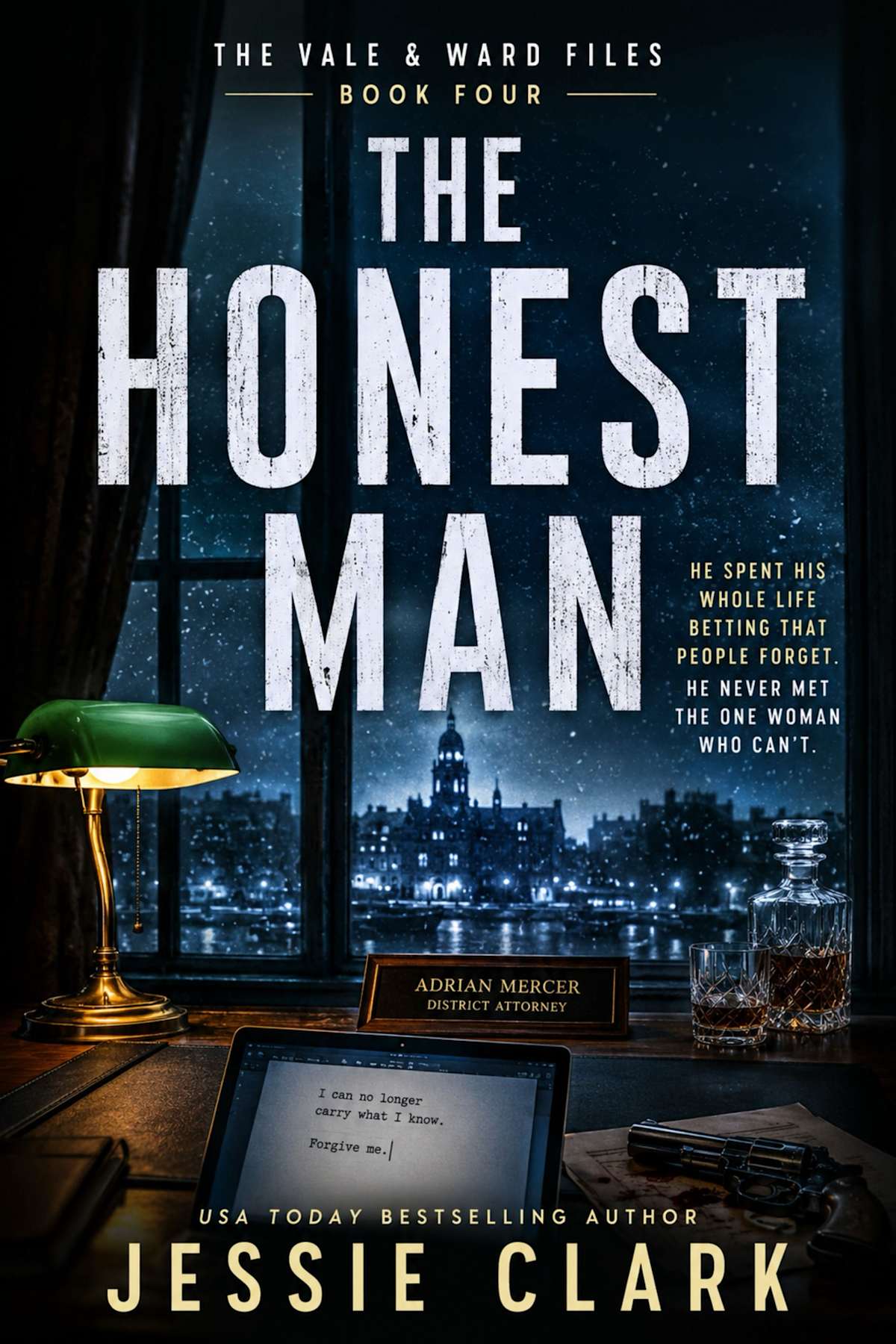
The First Honest Morning
A Vale & Ward Files bonus scene · Jessie Clark
Set the week after The Honest Man. Ethan Ward’s point of view. ~1,550 words. Newsletter reader magnet.
Ward woke before her, which almost never happened, and lay still so he wouldn’t wake her, which never happened at all.
The snow had finally stopped sometime in the night. He could tell without opening the blinds; the light coming through them had changed from the flat gray churn of a storm to the clean hard white of a city that had been buried and was, for one morning, pretending to be innocent about it. The radiator ticked. Down on the avenue a plow scraped past, dragging the night’s accumulation into a wall along the curb that some kid would climb later and some old man would curse. Ordinary sounds. The sounds of a city that had run a banner headline four days ago and was already, in its bones, beginning the long work of forgetting.
Cass slept against his shoulder with one hand curled loose on his chest, and Ward watched the ceiling and counted her breathing, because he counted things when he couldn’t stand them, and he was finding, this morning, that he couldn’t quite stand how much he wanted to keep this.
That was the thing nobody warned you about. Not the danger. He’d been built for danger; the Army had seen to that, and what the Army hadn’t finished, the job had. He knew exactly what to do with a man coming through a door with a gun, knew it in his hands before his head caught up. What he had never once been trained for, in any uniform, was the morning after the door — the soft white light, the loose hand on his chest, the precise and terrible understanding that he had something now that could be taken from him, and that he had spent his whole life arranging things so that he’d never have it again.
Danny used to sleep like this. Heavy and complete, the sleep of a person who trusted the room. Ward hadn’t thought of his brother in a bed in years, but the case had pried that door open and it wasn’t closing as fast as he’d have liked, and so now, some mornings, Danny was just there — fifteen and impossible, sprawled across a couch in a house that didn’t exist anymore, and Ward standing in the doorway in his first set of fatigues, certain beyond argument that he was leaving to make the world safer for exactly that, for that sleep, for that trust. He had been so sure. He had been nine thousand miles away and so sure, right up until the phone call.
He’d told Cass about it. In the kitchen, over soup, with the snow coming down. He hadn’t planned to. He’d spent two years not planning to, and then the case had put a lens on his chest and a red dot over his heart, and somewhere in him a wall he’d thought was load-bearing had simply come down, and he’d found that the building still stood.
That was the part he kept turning over. The building still stood.
Cass shifted, and her breathing changed — not the ragged catch of a nightmare, she didn’t really get those, her horrors all came while she was awake and could file them properly — but the slow surfacing of a woman who slept the way she did everything, deliberately, on her own schedule. Her hand flattened against his chest. He felt her come up into the morning and take it, all of it, the way she took every room: the light, the radiator, the plow, the wall he’d let fall, the fact that for once neither of them had anywhere to be that the other one didn’t know about.
“You’re awake,” she said, not opening her eyes. “You’re never awake first.”
“I’m savoring my novelty.”
“You’re brooding. I can hear the gears.” She tipped her head back to look at him, and there it was, the thing he’d given up expecting to find on anyone’s face when they looked at him — not fear, not need, not the wary calculation of a person deciding how much of him to trust. Just attention. The complete, unhurried, unforgettable attention of the one person alive who would remember this exact morning, this light, this conversation, perfectly, for the rest of her life, whether she wanted to or not. “What is it.”
He thought about deflecting. They were good at deflecting; they’d built six months and then two years on a foundation of well-timed deflection, on the careful inches, on the rule they didn’t say out loud. And then he remembered the rule they’d made in the dark before Crane Street, the only one that mattered now. No more careful.
“They closed Marsh out yesterday,” he said. “Quiet retirement. Full pension. There’s going to be a little cake in the break room on Friday, and people are going to shake his hand.”
“I know.” Of course she knew. She’d have the date of the cake and the brand of it. “Does it bother you?”
“It bothers me that it doesn’t bother me as much as it should.” He watched the white light on the ceiling. “Marsh looked away because looking would’ve cost him a pension and three tuitions. And I keep thinking — that’s the whole machine, right there. Not Calloway. Calloway’s rare; you can catch a Calloway. The machine is a thousand Marshes, every one of them deciding, just this once, that the thing in front of them isn’t theirs to lose.” His jaw worked. “And I keep thinking about how easy it would be. To become one. Now that I’ve got something to lose again.”
Cass was quiet a moment. She didn’t rush to reassure him; she never did, and it was one of the reasons he believed her when she finally spoke, because her words had to get past the same merciless editor everything else did.
“You won’t,” she said.
“You don’t know that.”
“I know it the way I know everything.” She pushed up onto her elbow, and the loose hand became a deliberate one, flat over his heart, over the spot the red dot had found through a long lens a week ago. “You want to know how I know you won’t look away to keep me safe? Because the night they put a lens on you — the night they handed you the one excuse that would’ve let any reasonable man fold — you read the photograph, and you turned to me, and you said especially not you.” Her voice was even, clinical, certain, and under all of it, the warm thing she only ever let him hear. “Men who are going to become Marsh don’t say that. They say let’s be smart about this. They say we have to think about ourselves now. You said the opposite, in the worst hour of the case, with a gun coming for you. I was there. I’ll always be there. I can’t lose it.” She almost smiled. “It’s the one hostage situation that ever worked out in my favor.”
Ward looked at her in the clean white light, this impossible woman who carried every failure she’d ever had in perfect order and had still, somehow, decided to carry him too, and he felt the wall that had come down stay down, and the building stay standing.
“Lin’s tip,” he said. “The sealed case. You’re going to take it.”
“I’m going to take it.”
“It’s going to be exactly like this one. Somebody powerful, somebody buried, a room arranged to read clean.” He wasn’t arguing. He was just saying the shape of the future out loud, the way you check your ground before you put your weight on it. “It’s going to put us both somewhere with a lens on it again.”
“Probably.” She lay back down against him, settling her ear over his heart, and he felt her start to count it, the way she counted everything, turning his pulse into one more thing she’d keep. “But here’s what they’re never going to understand, Ethan, the powerful ones, the buried ones, the men who arrange the rooms. They think the dangerous thing about me is the memory.” The plow scraped past again, farther off now, dragging the snow away. “It isn’t. The memory just makes me a witness. The dangerous thing is that I finally have something I refuse to forget on purpose.”
Outside, the city was already at its oldest work, hauling the night’s white innocence to the curb, getting ready to forget that it had ever been buried at all.
Inside, for one more hour, in a room with no lens in it, neither of them moved.
— end —
Want more of Cass and Ward? The next Vale & Ward File is coming. Stay on the list at www.jessieclarkauthor.com.